Defi lending is currently the second-largest sector in DeFi by TVL, according to DefiLlama, boasting over $40B in total value locked, led by Aave, which accounts for more than 25% of the entire sector.
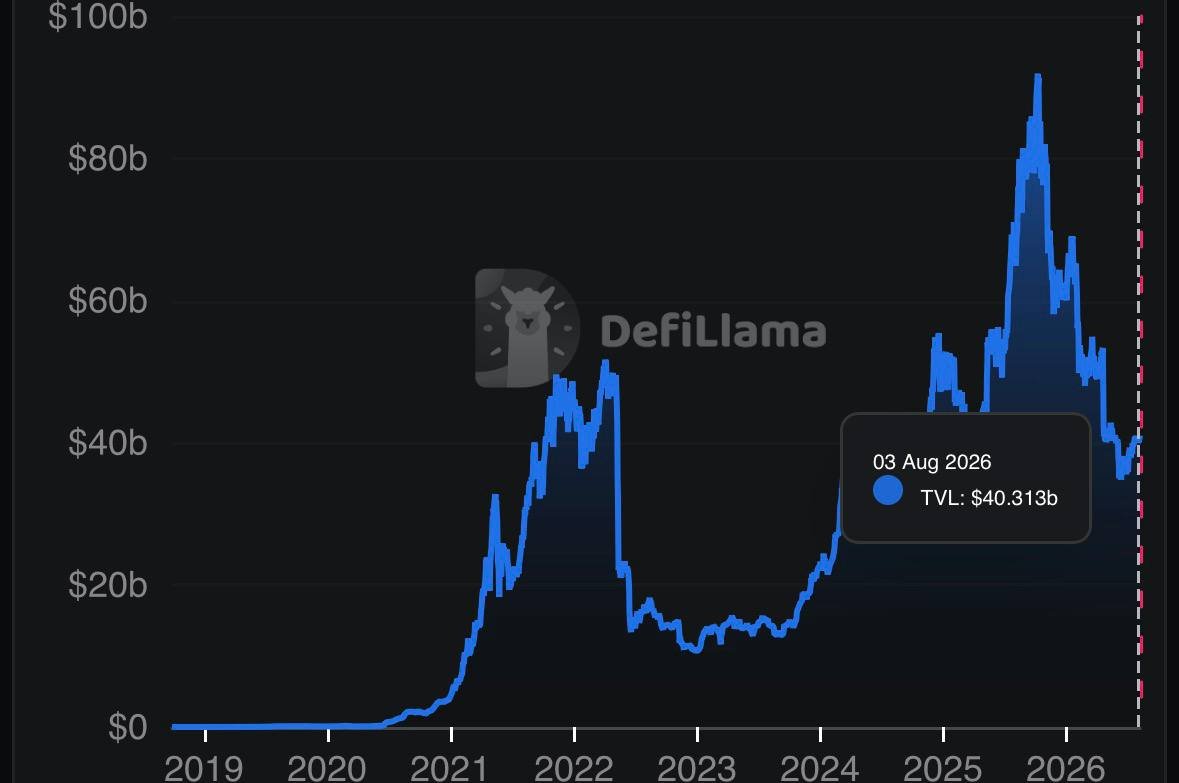
Crypto lending is one of the most revolutionary ideas invented by DeFi and has been evolving since 2017. The reason crypto lending works so well is that users can lend and borrow directly from smart contracts, eliminating the need for intermediaries.
Unlike real life, where you need collateral, work history, and other financial records to get a loan, crypto lending only requires you to overcollateralize your crypto assets against the amount you want to borrow.
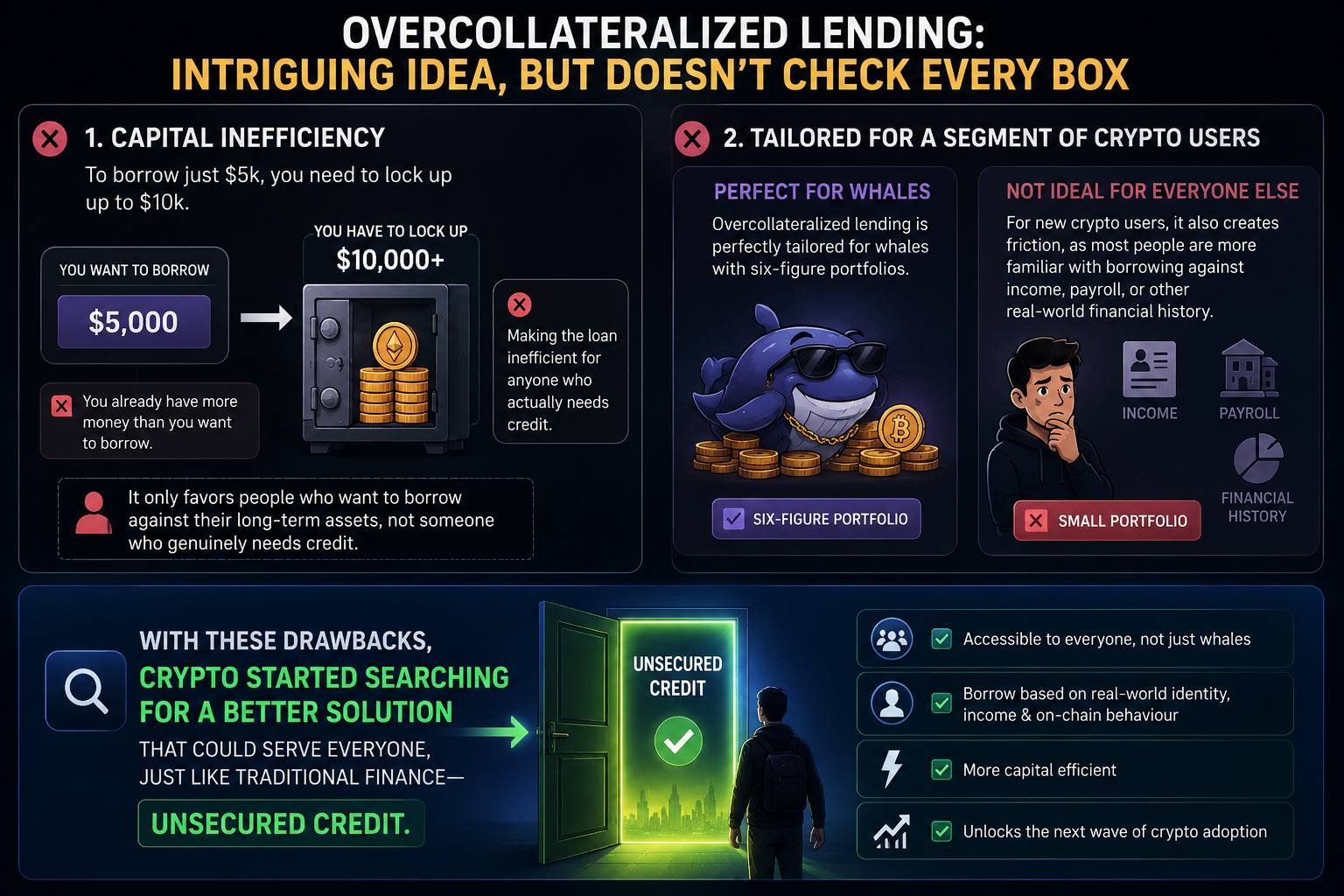
While the idea of overcollateralized lending is intriguing for most crypto users, it doesn’t check every box:
- Capital inefficiency: To borrow just $5k, you need to lock up to 100%. You have to have more money than you want to borrow, making the loan inefficient for anyone who actually needs credit.
It only favors people who want to borrow against their long-term assets, not someone who genuinely needs credit.
- Tailored for a segment of crypto users
Overcollateralized lending is perfectly tailored for whales with six-figure portfolios, not someone with a small portfolio.
For new crypto users, it also creates friction, as most people are more familiar with borrowing against income, payroll, or other real-world financial history.
With these drawbacks, crypto started searching for a better solution that could serve everyone, just like traditional finance—unsecured credit.
Unsecured credit works so well in TradFi because lenders have extensive access to borrower data, including credit scores, bank history, existing loans, and legal enforcement in the event of default.
Crypto saw this as a massive opportunity to build a lending market tailored for everyone finally.
And we’ve had a lot of failed experiments.
1. Maple Finance
Maple was founded by two Australian credit professionals with traditional debt capital market backgrounds.
Their core idea was to create a decentralized institutional credit marketplace where:
- Lenders could earn yield from real loans.
- Borrowers were KYC-verified crypto institutions (hedge funds, market makers, etc.).
- Instead of Aave, where you need more collateral than you borrow, borrowers needed far less collateral.
- Pool delegates performed off-chain credit assessments and negotiated loan terms.
The idea worked well at the beginning.
In just 10 months, Maple originated over $1 billion in loans, proving the market was hungry for this innovation.
It was far more capital efficient than Aave’s model, which is one of the reasons behind its early success despite targeting a niche audience.
Then came the FTX collapse.
At its peak, Maple had around $54 million in defaulted loans.
This wasn’t a bug; it was a feature of the model.
When borrowers stopped paying, Maple couldn’t liquidate anything on-chain.
They had to rely on courts, lawyers, and negotiations that could take months or even years to resolve.
This exposed the core weakness of the unsecured model: heavy reliance on off-chain human underwriting with no efficient enforcement mechanism.
2. TrueFi
TrueFi was one of Maple’s biggest competitors and another early pioneer of unsecured credit.
Like Maple, it focused on institutional borrowers such as crypto trading firms and market makers.
At the peak of the 2021 bull market, it was a huge success.
Cumulative loan originations exceeded $1.7 billion, with more than a billion dollars repaid.
Then came the FTX blow-up.
TrueFi was hit hard by the crypto credit crunch.
Borrowers like Blockwater Technologies and Invictus Capital defaulted, resulting in millions of dollars in bad loans.
TVL collapsed as lenders withdrew their capital.
Like Maple, they depended on lengthy legal processes and negotiations because there was little collateral to seize.
3. Goldfinch
Unlike Maple and TrueFi, which mainly lent to crypto-native firms, Goldfinch focused on real-world private credit, especially in emerging markets.
- Fintechs and small businesses across Africa, Latin America, and Southeast Asia.
- Real-world borrowers who traditionally lacked access to affordable capital.
Its model had two layers:
- Backers performed due diligence, took first-loss risk, and earned higher yields.
- Senior Pool provided passive capital with lower risk and lower returns.
Loans were largely uncollateralized or only lightly collateralized off-chain.
Capital came from crypto (mainly USDC) and was lent to real-world borrowers.
While this sounded like a more sustainable model, it eventually ran into the same problem.
At its peak, Goldfinch originated roughly $100 million in loans.
It later experienced significant borrower defaults, including:
- Tugende
- Stratos
- LendEast
Together, they accounted for more than $10 million in defaults, and cumulative losses kept growing.
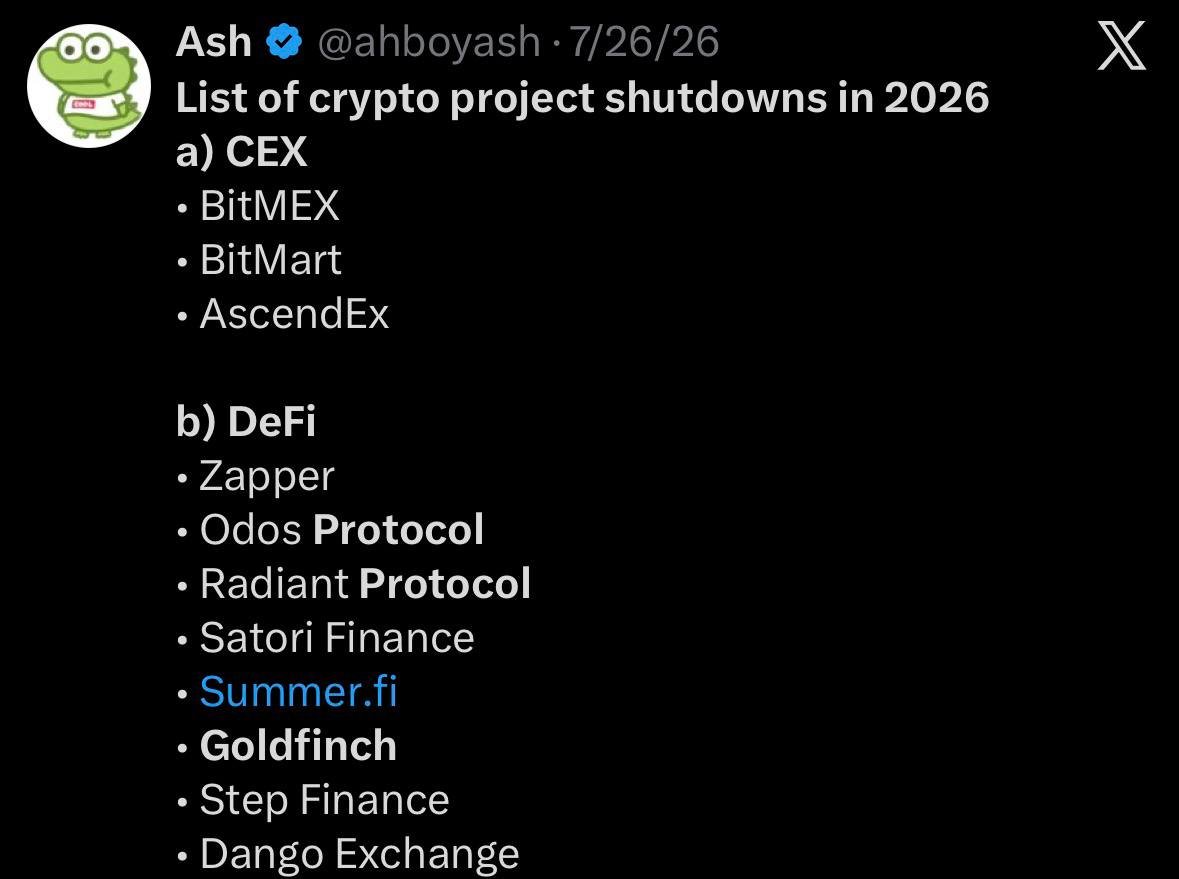
Last month, the protocol entered maintenance mode.
The biggest mistake all three protocols had in common was relying too heavily on “trust me, bro” data instead of properly verifying whether borrowers could actually repay.
They lent money without enough real collateral.
They trusted reputation, agreements, and manually reviewed financial information.
When borrowers defaulted, legal action turned out to be slow, expensive, and often ineffective because there was very little to seize.
While much of the market has moved away from institutional unsecured lending after these failures, we’re seeing more attention shift toward building credit products for everyday users.
We at @cr3dentials are taking a different approach by addressing one of the biggest flaws these earlier protocols faced.
The problem with previous unsecured lending models is that they relied too much on “trust me, bro” data with no reliable way to verify how solvent borrowers actually were.
They relied on:
- Self-reported numbers
- Old financial statements
- Reputation
- Manual underwriting that could easily be gamed
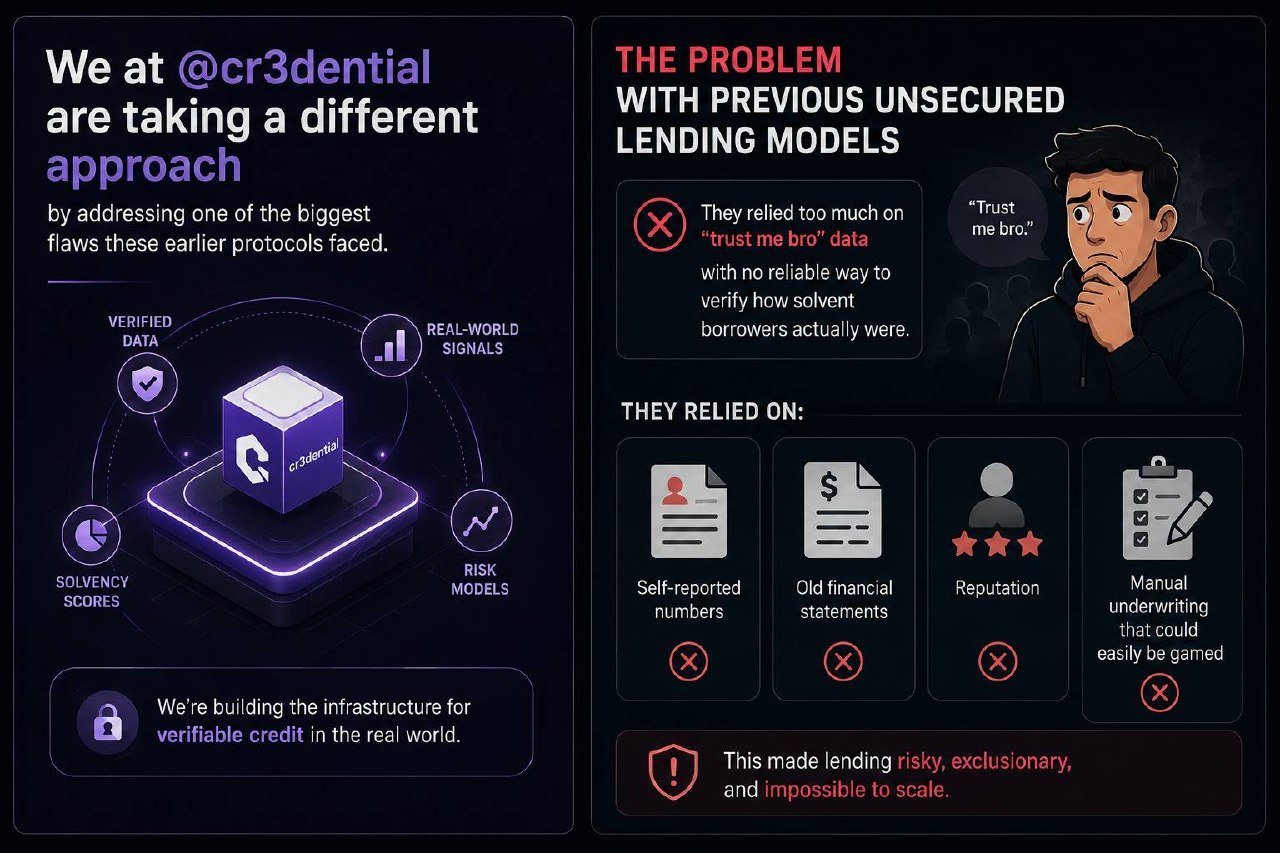
Instead, we’re building the credit infrastructure, the data layer that helps lenders make better decisions.
And we aren’t building for just any institution.
We’ve tailored the product for the group that makes up a huge portion of crypto users today, gig workers.
Freelancers, traders, Bolt drivers, YouTube creators, X creators, and anyone earning income online.
As you’re reading this, chances are you’re either one already or know someone who is.
That’s what’s beautiful about building for this audience.
It feels like building for everyone because almost everyone participates in the internet economy in one way or another.
With @cr3dentials, crypto neobanks and lenders can verify financial data directly from the source using zkTLS, not self-reported information.
They can verify income, payouts, account activity, and account ownership without exposing unnecessary user data.
The second problem with the landscape of unsecured lending is enforcement.
Even when projects assess a borrower’s financial history, what happens when they default?
We’re working alongside local jurisdictions to make enforcement happen, not just relying on outdated court processes and lawyers. We’re building systems that create real consequences for future borrowing.
For instance, in Africa, we’re working on a way to connect a person’s BVN to the loans they receive, so any default can be reflected in their off-chain banking profile, just like traditional loans.
In the U.S., we’re working with agencies that lenders can always sell a loan to a collection agency that recovers the money on the lender’s behalf.
Repayments happen before borrowers receive all of their income, and we’ll continue integrating with as many platforms as possible.
That way, both lenders and borrowers are protected without needing to constantly watch each other’s backs.
Crypto already solved global transfers, stablecoin payments, and even yield generation.
But the next real unlock is giving users access to credit without forcing them to overcollateralize with crypto assets first.
Because at the end of the day, most normal users don’t have a large crypto portfolio sitting around to borrow against.
They just have income, cash flow, online earnings, and digital reputations spread across platforms like Upwork, Uber, Stripe, Shopify, or YouTube.
The infrastructure that can verify those income sources privately and reliably will likely become one of the most important layers powering the next generation of crypto neobanks.
If you’re building unsecured credit on stablecoin rails,
We want to work with you.
DM us ��