Lending is one of the highest-margin businesses in a neobank and often becomes one of its biggest profit engines.
When a neobank wants to charge people for moving money, it can’t charge as much as it would like because there’s always a competitor offering lower rates. So being just a financial institution that holds people’s money and sends money in and out is only the beginning of becoming a full-stack neobank, not the end.
But in the case of credit, the APR can go as high as 20%. You can charge as much as you want, considering the risks you’re taking to give out these loans to your customers. That way, it poses itself as one of the high-margin businesses in the entire neobank stack, though a 20% APR isn’t always the gain a neobank makes when a customer pays back a loan.
To understand that, we wrote an article about the hierarchy involved before a loan gets to you through the repayment in the article below.
Read: 10% APR loan doesn’t mean the lender is making 10%
Every segment is costing a % of what a lender gives out, so every time they give out a loan, they need to share the profit evenly with partners and projects that help in the process, which in a way makes getting credit costly in traditional finance.
Top neobanks offering credit are taking in over a billion in revenue:
Nubank made a total of over $15B in revenue in 2025.
Revolut did $6B.
LendingClub did nearly a billion dollars.
And the list just goes on and on.
While these, at the same time, have their loan portfolios and user base growing massively in the same timeframe.
One of the most interesting things about this is that you don’t need much marketing to run a proper neobank giving out credit. The demand is always there. You just have to know deeply who you are lending to and how rigorously risk is being coded into your underwriting so you don’t go bankrupt.
Lenders always want to charge as much as they can because different customers require different levels of risk, since unsecured lending doesn’t require a customer to have proper collateral like a bank, where you have to use something valuable equivalent to the money you want to lend: house, car, etc.
Neobanks offering unsecured lending focus a lot on your reputation instead, with the ability to pay back when they lend you money: consistent cash flow, transaction history, spending patterns, existing debts, etc.
For them to give out loans to any customer, they tend to underwrite them differently. Imagine these two customers:
User A
- earns $3,000/month
- receives salary through the app
- spends $1,500/month
- has stable cash flow
- never misses repayments
User B
- earns $600/month
- income is irregular
- has no traditional credit history
- frequently runs short before payday
Under normal circumstances, a neobank would price B’s loans much higher to compensate for the additional default risks. But they can’t due to usury caps.
Usury caps are basically interest rate ceiling limits on how much a lender can charge for credit, and this varies across regions.
With usury caps, both users A and B are subject to the same interest rate caps that a lender can put on their loans. That’s why most of the time, when a neobank system detects that user B has been too risky, they won’t count them as eligible instead of giving out loans to them with a higher APR due to the usury caps.
Looking at usury caps in Latin America, you can see Uruguay come in at over 100%, while countries like Ecuador come in at 16.8%. This determines the fate of people getting loans legally from these regions, depending entirely on these rates.
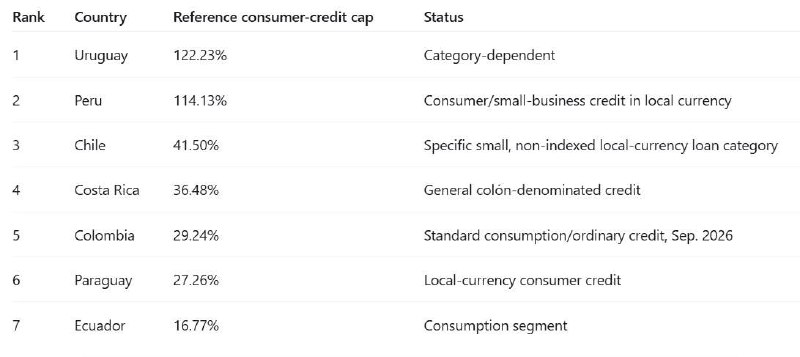
The equation is different in two regions due to these differences:
high cap → more pricing room → lender can tolerate more risk → potentially more borrowers served → but borrowers who get loans can pay much more
whereas:
low cap → less pricing room → lender must control default/operating costs → stricter underwriting → potentially fewer risky borrowers get formal credit → successful borrowers pay less
So in countries with lower usury caps, it doesn’t mean bad economies. It just literally means lenders can’t solve bad underwriting by simply charging more.
In most of these markets, when lenders don’t have much information on the borrowers due to limited information provided by credit bureaus, they tend to reject the borrower or just give them lower loans instead, as they couldn’t just price risk in their APR as they wanted due to the usury cap.
Usury caps protect consumers, but they do not erase a lender’s costs: funding, underwriting, servicing, defaults, and capital.
In a situation where the lender can’t price the risk properly and is constrained by available solutions like bureaus, the lender is never the problem, but the fault lies in the underwriting.
That’s where we come in, @Cr3dentials.
Credit bureaus will mostly show a lender what loans the person already has, repayment, current debt, whether they default, etc. But they don’t get other information about that borrower, whether they are working online or not. The bureau doesn’t know that.
It’s primarily giving the lender historical credit behavior, not where the person is earning.
With what we are building at @Cr3dentials, we tend to move the house question from “How have you handled credit before?” to “How do you actually earn and manage money?”
We tend to go deeper into the borrower’s daily life: what they do every day, how consistently they get paid, any upcoming payments, how long they’ve been freelancing, how often they get paid, etc.
We don’t just focus on the credit. We tend to focus on the source of the money they will use to pay back the loan in the first place.
Combined with this, we also incorporate other components into our underwriting engine to make it battle-tested and to have good judgment when rating individual lenders. For instance, we also do repayment, recourse, and even enforcement.
We make sure we help projects handle all the heavy lifting they’d need to do manually in-house.
We already live in most places where people earn online, like Upwork, Stripe, Uber, YouTube, and Shopify, with more integrations expected in the future.
It’s even better: we are focusing on the niche individuals that make the internet tick, the traditional finance neglected here. They don’t need a credit score for creditworthiness. As long as they earn from somewhere, they are eligible, given they meet the terms and conditions of the lenders.
When a neobank focuses on this segment of users, they are going to get into an untapped market because, firstly, only a handful of people get access to loans due to lower usury caps. And with internet proliferation, where everybody earns online, the guess is most people are focusing on this region, and using our battle-tested underwriting is the best combo to offer competitive rates, where traditional lenders are constrained by the information provided to them.
When you’ve got good underwriting, the biggest problem a project faces is starting capital to pull the whole thing together.
That’s where we @Cr3dentials offer not only our battle-tested underwriting system but also a capital facility through our partnership with Tradevu.
With this, neobanks can get access to up to $200K in capital, with a maximum of 5 neobanks, and we plan to extend this program.
The first cohort ends in less than two weeks: Oct 10.
Don’t miss out. Register here: https://bit.ly/4h7Mwie
All you need to do is bring your users. We handle all the heavy lifting for you.
DM us if you have more questions about this program.