The biggest problem in lending isn't demand. It's capital + underwriting
Good underwriting is one part of building a good, successful credit product, but access to capital is equally important.
When a neobank taps into Cr3dentials underwriting, it covers the heavy lifting they’d have to build in-house: the data, repayment, recourse, and enforcement. What if the project didn’t have anything to lend?
Our partnership with Tradevu brings these pieces together through a $1M credit program, where neobanks have access to up to $200K to lend to customers. At the same time, everything is gated and monitored on the Cr3dentials network through repayment.
If you’re a neobank, fintech, wallet, etc. that wants to lend to customers but is constrained by capital and good underwriting, our credit facility is tailored for you.
Apply here: https://bit.ly/4h7Mwie
Through this program, we’ve solved one of the cold-start problems that the founder of one of the biggest neobanks giving credit is facing, which delayed them for years before they finally came out.
Having capital and good underwriting.
Every one of the behemoths has gone through a stage of either having a problem with capital constraints or having faults in their underwriting engine.
1. LendingClub
LendingClub started as a Facebook application in 2007. The goal was simple: let individuals fund consumer loans peer-to-peer.
While the business worked, the regulators weren’t happy. The SEC came into their business as early as a year after launch, calling their notes unregistered securities.
They first had to shut the lending business down for six months in the middle of a financial crisis. It reopened as a fully SEC-registered offering.
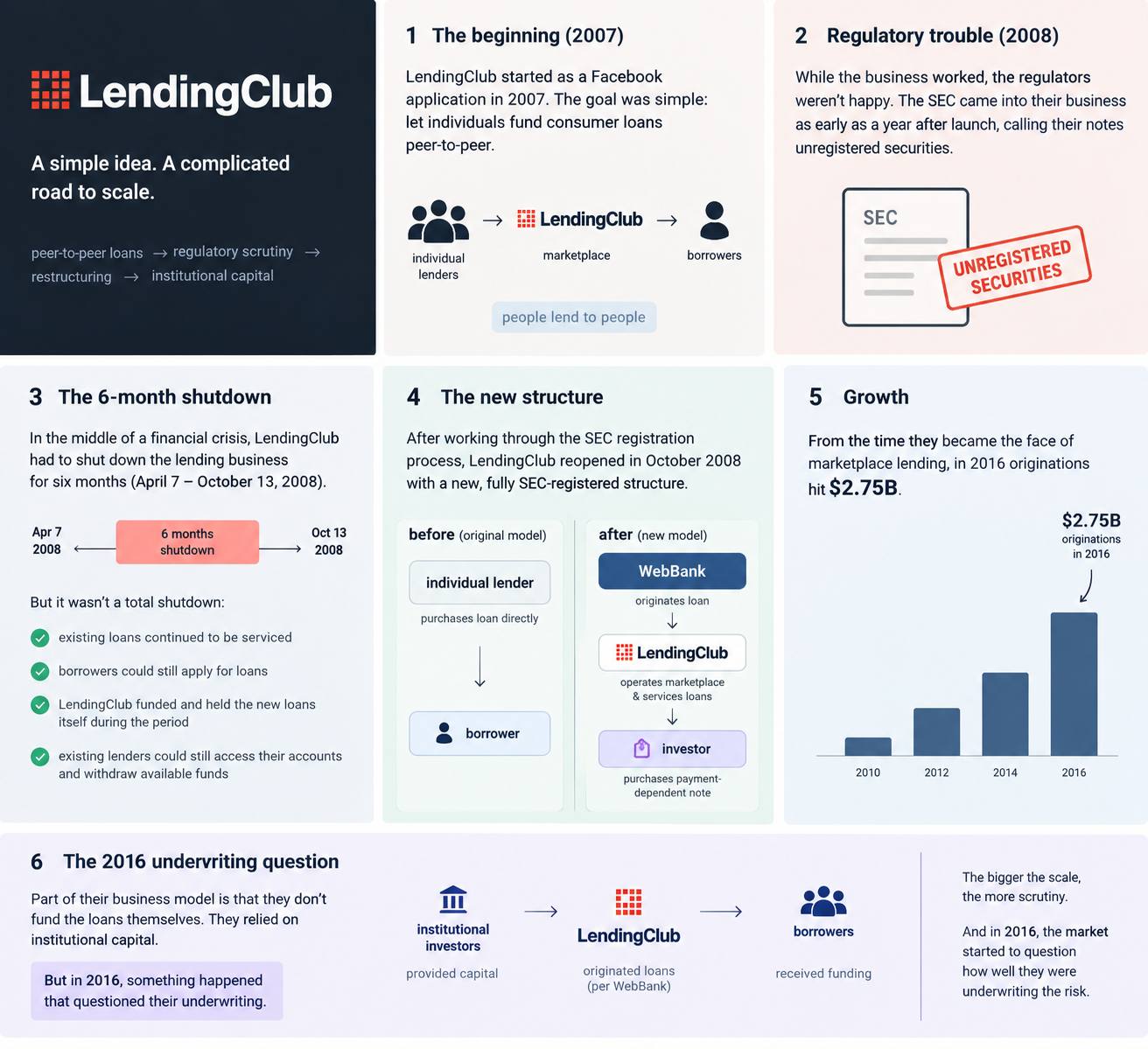
Unlike before, when consumers funded the loans directly, they were restricted, so the loans were originated by WebBank rather than funded by individuals.
From the time they became the face of marketplace lending, in fact, in 2016 originations hit $2.75B.
Part of their business model is that they don’t fund the loans themselves. They relied on institutional capital. Something happened in 2016 that questioned their underwriting.
LendingClub sold $22M to an investor, but employees changed $3M of the loans to make them appear compliant.
This later turned into a disaster. The CEO resigned, and employees left. This wasn’t only about the money alone, but it was about investor trust.
If they could do this to this particular money, what had been going on behind the scenes of other loans?
So investors stopped funding. They later had to resort to funding in-house, which literally meant fewer loans funded.
They later made a strategic pivot through the acquisition of Radius Bank for $185M. This gave them access to the capital they couldn’t have in the early years: stable, low-cost deposit funding and the ability to hold loans on its own balance sheet.
As of Q1 2026, total assets on their balance sheet are over $10B, with more than $5B in total loans, growing tremendously from where they’ve started.
2. SoFi
SoFi’s original idea was for alumni (former students/graduates of a university) to fund the loans of students at their own school.
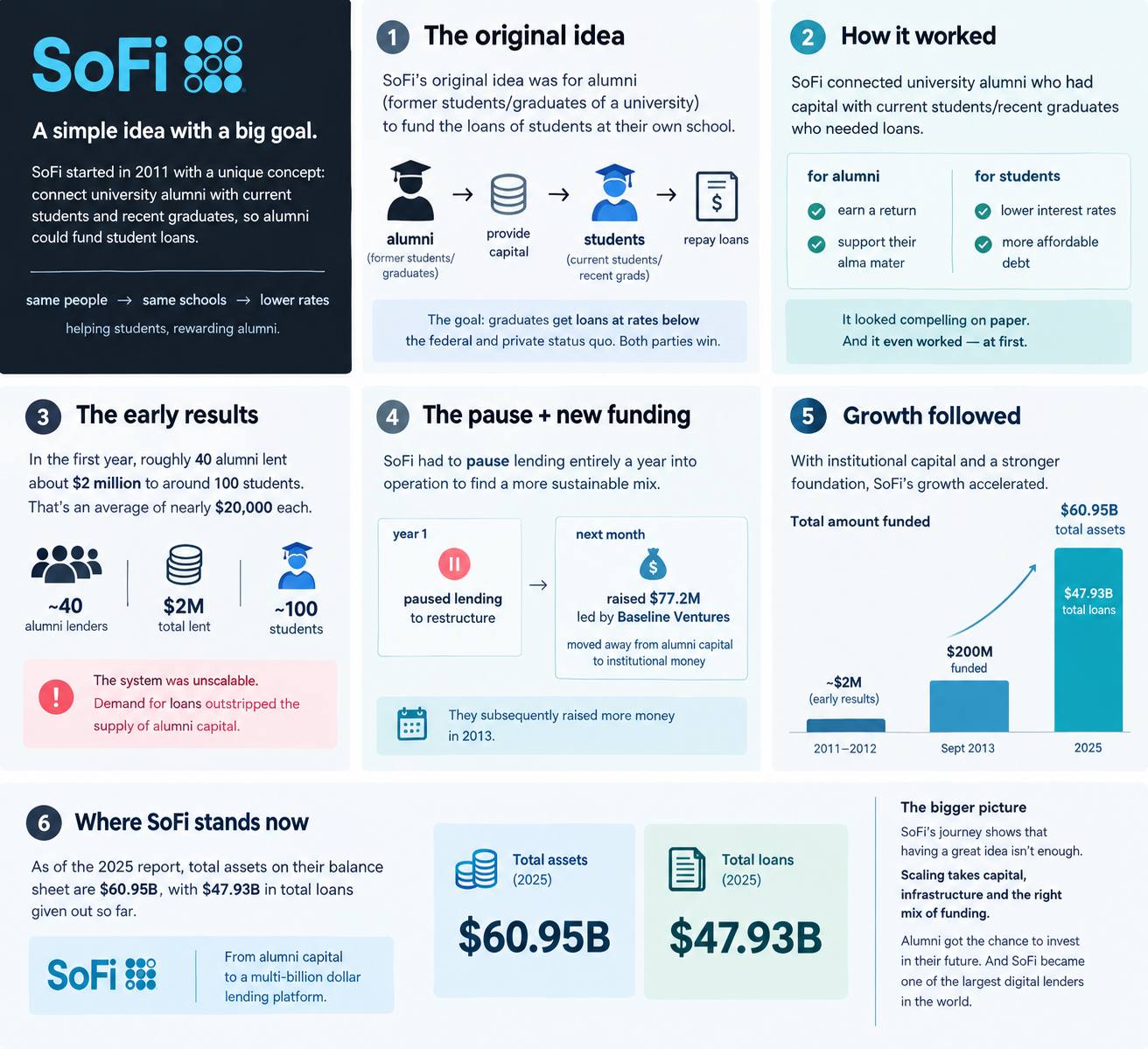
SoFi started in 2011 by connecting university alumni who had capital with current students/recent graduates who needed loans. The idea was basically:
alumni → provide capital → students → repay loans
The catch there for a student is you get rates below what federal and private lenders offer. So both parties win. Alumni earned a return. Graduates got cheaper debt.
While this system looked compelling on paper and it even worked, roughly forty alumni lent about $2 million to around a hundred students, an average near $20,000 each. In September 2012 they raised $77.2M led by Baseline Ventures and used part of it to bring more alumni onto the platform at more schools.
That still wasn't enough. Demand for loans kept outstripping the supply of alumni capital, and in November 2012, about a year into operation, SoFi had to pause lending entirely. They had done around $90M in loans by then.
Lending only came back in April 2013, and this time the money came from a Morgan Stanley warehouse facility, not alumni. By October 2013 they had raised $500M in debt and equity to fund loans, and the alumni model basically got replaced by institutional capital from that point on.
Growth followed the funding, and it has been up only since then. As of the 2025 report, total assets on their balance sheet are $60.95B, with $47.93B in total loans given out so far.
3. Nubank
Unlike the others on the list that started their journey by giving out loans directly to customers, Nubank took a completely different route.
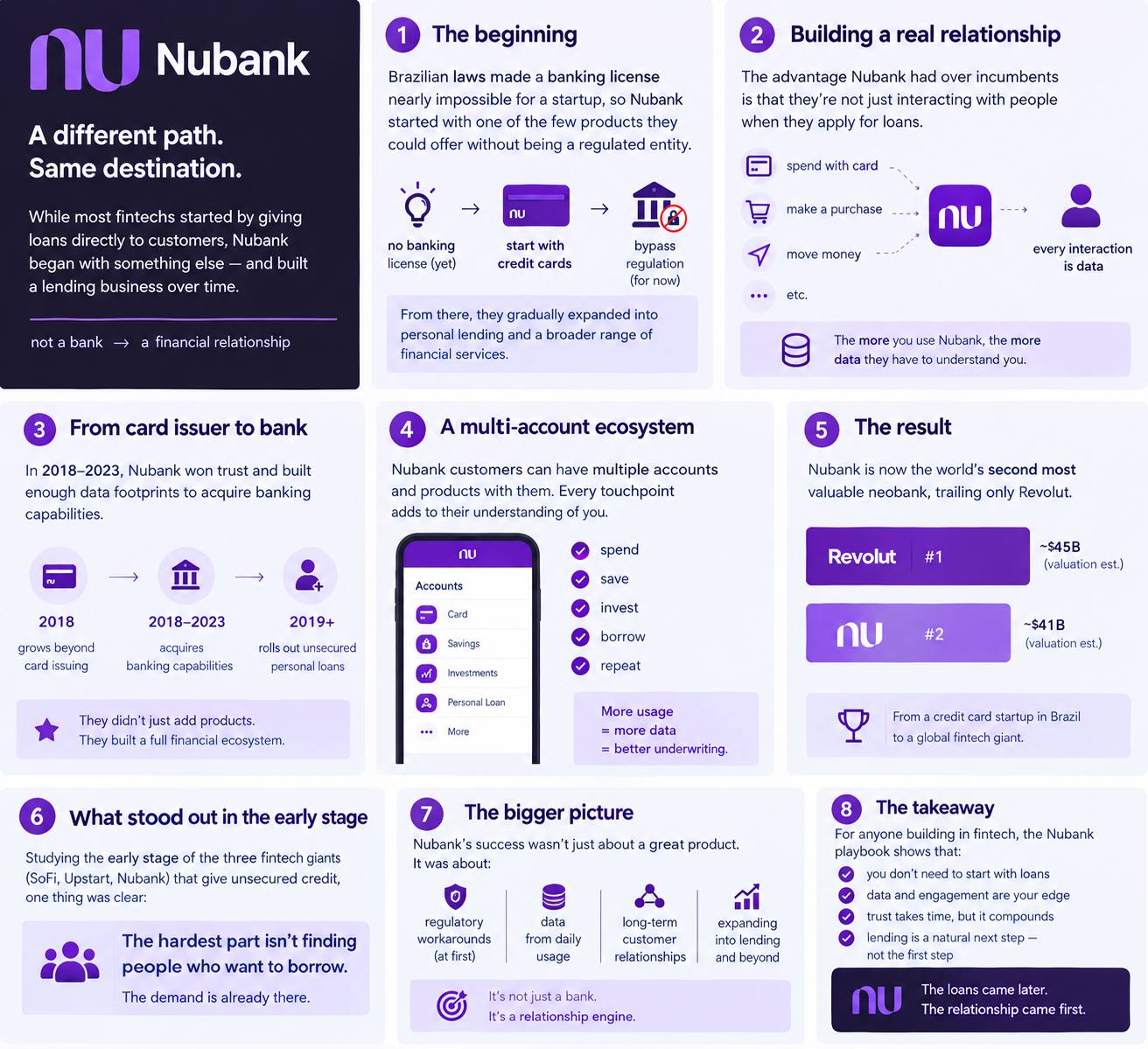
Nubank was founded when Brazilian laws made a banking license nearly impossible for a startup, so they started with one of the few products they could offer without being a regulated entity.
The company began with products such as credit cards and eventually expanded into personal lending and a much broader financial-services relationship.
The advantage that Nubank had over any other incumbent is that they are not just interacting with people only when they apply for loans.
They are building a relationship that later turns into data to underwrite them.
A customer can have multiple accounts with them:
Spend with card
Make a purchase
Move money
etc.
Every customer interaction is data to understand them better.
In 2018–2023, having won trust and enough data footprints, Nubank went from just a card issuer to acquiring banking capabilities.
From 2019 onward, they started rolling out unsecured personal loans to their massive, engaged ecosystem.
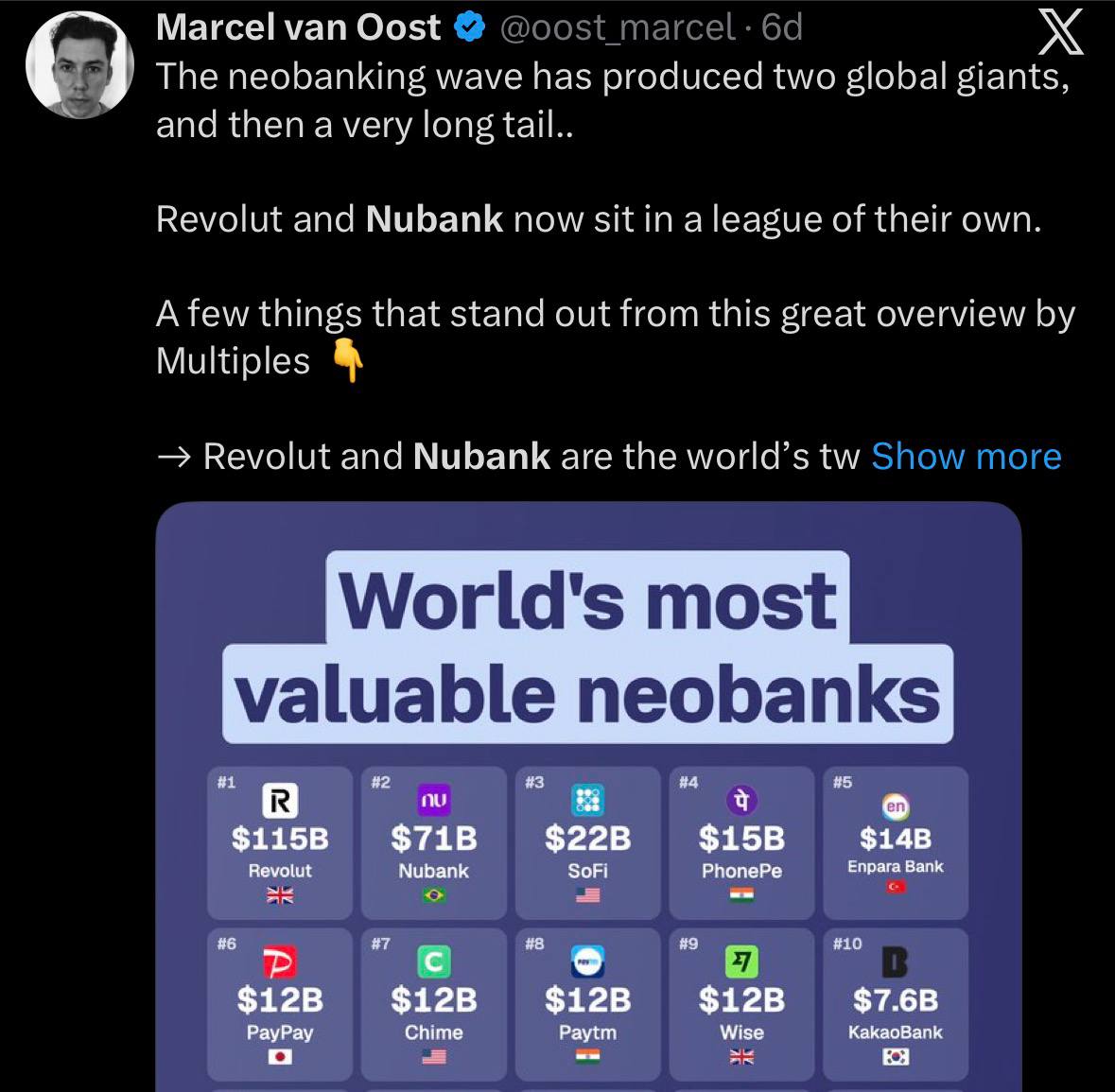
As it stands, Nubank is number two as the most valuable neobank in the whole world, trailing behind Revolut.
Studying the early stage of the three behemoths of fintech giving out unsecured credit to their customers, what stood out is the fact that the hardest part of building an unsecured lending business isn’t finding people who want to borrow.
The demand is already there.
The hard part is making capital comfortable enough to lend to those people.
And that usually comes down to two things:
capital + underwriting.
Early lenders always caught themselves in a chicken-and-egg problem.
They need capital to originate.
But capital wants strong underwriting and repayment performance before committing meaningful capital.
You need borrowers to generate repayment data.
But you need capital to lend to those borrowers in the first place.
So you end up with:
limited data → uncertain underwriting → limited capital → limited lending → limited data.
SoFi went through this.
There’s huge demand as the loans offered by alumni had more competitive rates than the ones you get from federal or private sources, but they didn’t have enough capital to fund it.
They had to prove the customers were actually worth funding, then bring in institutional capital to fund the demand.
LendingClub faced the same issue from another angle.
They built a marketplace connecting borrowers with investors.
You can have thousands of people ready to borrow and still not be able to lend if the capital side isn’t there.
Nubank shows that even when you’ve got the capital, you must also have good underwriting.
Just because you’ve got a huge user base to lend to doesn’t necessarily mean you have to give it out as you like without properly assessing who these people really are.
Are they going to pay back?
What’s their spending habit?
How regularly do they get paid?
etc.
All this can only be done if they are actually using your app to do transactions. What if you don’t want to start from the beginning building a relationship?
What if you want to learn who these people are to know who they really are?
That’s where @Cr3dentials data comes in. People don’t necessarily need to use your neobank for years to understand them.
With our data, you can meet them where they are working across multiple platforms: YouTube, Shopify, Airbnb.
You can know how regularly they get paid, upcoming payments, how much they earn, and access the amount you can go in to issue based on the information.
And the interesting part is, with our $1M credit facility, you don’t even need to lift a finger for anything, as we handle everything from backing the data to issuing them the loan through repayment.
All you need is to just bring users and chill. We got your back on every other thing going on in the background.
It has never been easy to lend unsecured credit out as a neobank.